
NEWS
Pale Blue Selected for Space Strategy Fund Project “Technology to Realize Flexible Spatial Mobility” Launching Full-Scale Development and Commercialization of Micro-OTV
CHIBA, Japan (Jan.30) – Pale Blue has been selected for the technology development theme “Technology to Realize Flexible Spatial Mobility (A) Development of Orbital Transfer Vehicles” under the Space Strategy Fund led by the Japan Aerospace Exploration Agency (JAXA). In collaboration with the University of Tokyo, Pale Blue will commence the development of a Micro-OTV (Orbital Transfer Vehicle) and officially enter the orbital transfer service market as a new business pillar.
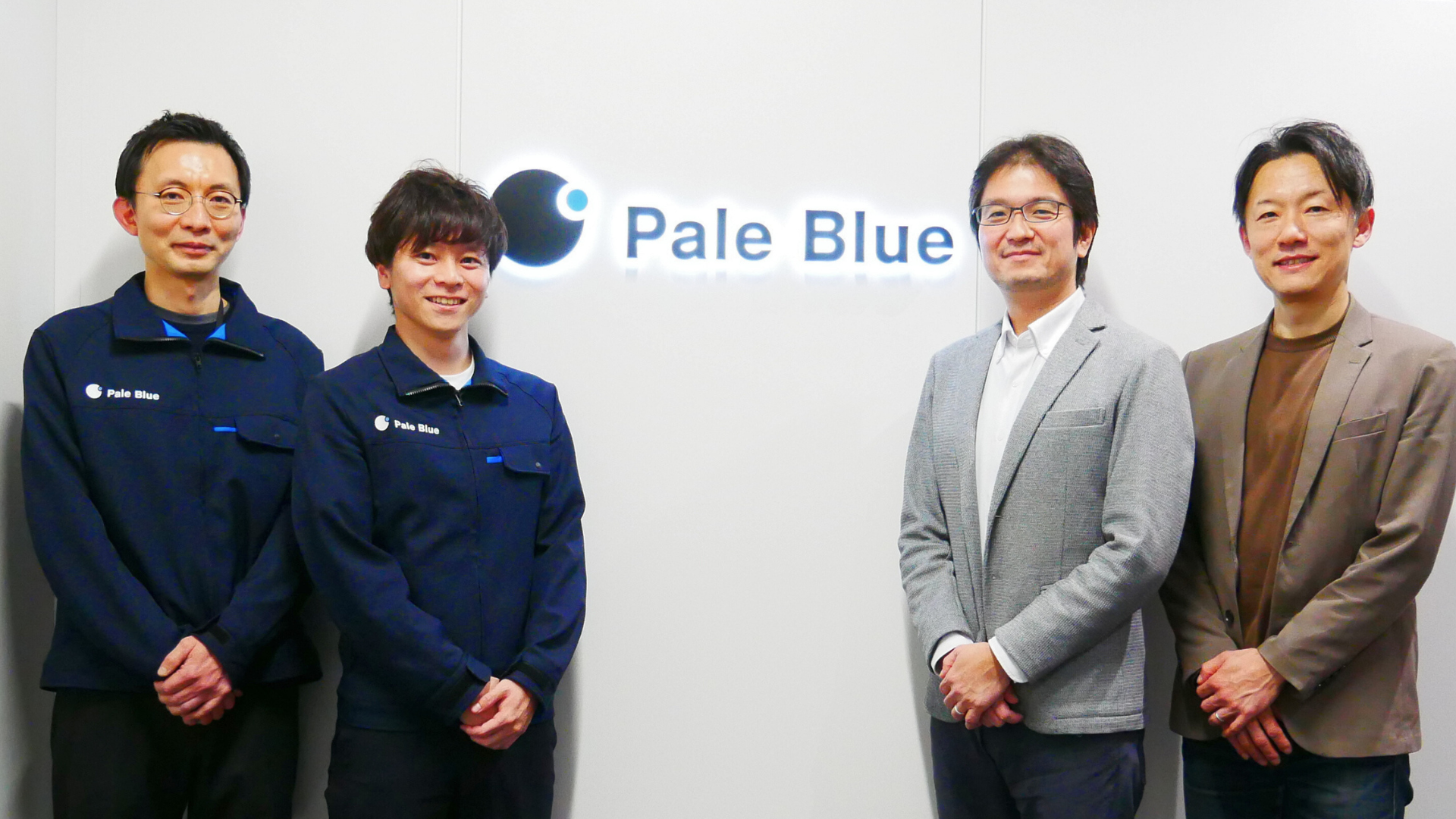
From left to right: Hitoshi Inomata (Product Manager, Pale Blue), Jun Asakawa (Co-founder & CEO, Pale Blue), Ryu Funase (Associate Professor, The University of Tokyo), and Hiroyuki Koizumi (Associate Professor, The University of Tokyo).
An Orbital Transfer Vehicle (OTV) is a spacecraft designed to navigate between diverse orbits after separation from a launch vehicle. OTVs are poised to revolutionize space logistics by facilitating the development of infrastructure such as satellites and bases, as well as the transportation of payloads. Under the Space Strategy Fund project, Pale Blue will develop a high-frequency, flexible Micro-OTV capable of reaching various target orbits, including the Cislunar region (between Earth and the Moon) and beyond. By leveraging its proprietary propulsion systems as a core technology, Pale Blue is officially entering the OTV business.
In recent years, a large-scale “trunk line transportation” infrastructure—centered on large rockets and heavy OTVs—has begun to take shape to serve as the primary transport infrastructure for movement in space. However, as the space economy expands, large-scale systems alone cannot meet the emerging demand for pinpoint delivery to diverse orbits. The lack of flexible access, particularly to the Cislunar region and beyond, remains a significant bottleneck. Pale Blue aims to resolve these infrastructure gaps by providing “branch line transportation” via Micro-OTVs, further pioneering the expansion of the space economy.
Collaboration with the University of Tokyo: A Global Leader in Micro-Spacecraft Heritage
In this Space Strategy Fund project, Pale Blue will work in close collaboration with the University of Tokyo, which holds a world-class track record in the utilization of micro-spacecraft. The University of Tokyo has accumulated extensive expertise in the development and operation of micro-spacecraft through numerous missions. These include the “Hodoyoshi Project” (funded by the Cabinet Office’s FIRST Program), as well as the micro-deep space probes “PROCYON” and “EQUULEUS.” Within this project, the University of Tokyo will lead the development of orbit control and autonomous operation technologies, as well as the engineering of spacecraft capable of withstanding deep space environments.
Space Strategic Fund: Project Overview
Technology Development Theme: (A) Development of Orbital Transfer Vehicles, Technologies to Realize Flexible Spatial Mobility
Technology Development Project: Development of Micro-OTVs for Branch-Line Transportation Beyond Cislunar Space
Lead Institution: Pale Blue Inc. (Principal Investigator: Jun Asakawa)
Collaborating Institution: The University of Tokyo (Co-Investigator: Associate Professor Ryu Funase)
Related Information: https://fund.jaxa.jp/content/uploads/Overview_of_The_SpaceStrategy_Fund.pdf
Growth and Synergies through the Expansion into Orbital Transfer Services
As a key pillar of its growth strategy, Pale Blue is entering the Orbital Transfer Vehicle (OTV) business, leveraging its selection for the Space Strategy Fund. This venture is built around the integration of the company’s proprietary propulsion systems. In addition to accelerating the launch of orbital transfer services that maximize propulsion performance, Pale Blue will immediately incorporate insights gained from OTV development and operations into its core propulsion business. By simultaneously advancing both propulsion system and OTV, the company aims to enhance the competitiveness of the OTV itself while developing more user-friendly and reliable propulsion systems for satellite manufacturers. Through this synergy, Pale Blue seeks to accelerate the growth of both business lines.
About Pale Blue
Pale Blue develops and manufactures propulsion systems (engines) for small satellites, serving satellite integrators and operators worldwide. Since its founding in 2020, Pale Blue has successfully achieved in-orbit operations of propulsion systems a number of times, providing highly reliable solutions. While further expanding its product offering through R&D and in-orbit demonstrations, Pale Blue is also strengthening production capabilities to meet the growing demand for propulsion systems. Pale Blue is committed to creating mobility that is core to the space industry, driving the next generation of space development.
Website:https://pale-blue.co.jp/